




This past year, large language models (LLMs) like OpenAI's GPT-4 have reshaped the landscape of artificial intelligence (AI) and natural language processing (NLP). Agents leveraging LLMs offer enhanced solutions for a variety of NLP tasks, holding tremendous potential for modern applications. In this article, we'll investigate the importance of these agents, delve into their capabilities and constraints, and examine the methods for optimizing their performance. We will also explore the emerging capabilities and trends in this rapidly growing field.
I. The Role and Capabilities of LLM-Powered Agents
1. Conversational AI
LLM-powered agents have emerged as excellent tools for creating chatbots and virtual assistants that engage in more natural conversations. These agents can understand context, provide valuable answers, and offer recommendations, significantly improving user experiences.
2. Text Summarization
LLM-powered agents excel at distilling lengthy text passages into concise summaries, enabling users to quickly comprehend essential information without sifting through the entire content.
3. Machine Translation
Skilled in machine translation, LLM-powered agents help bridge language gaps and facilitate seamless communication among speakers of different languages.
4. Sentiment Analysis
These agents can analyze and interpret the emotions conveyed in the text, empowering businesses to assess customer feedback and devise targeted marketing strategies effectively.

II. Limitations of LLM-Powered Agents
1. Shallow Comprehension
Despite proficiency in syntax and context, LLM-powered agents currently lack deeper real-world understanding, sometimes leading to inaccurate or irrelevant responses.
2. Copyright and Plagiarism Issues
As LLMs like GPT-4 train on vast internet data sets, generated content may unintentionally infringe copyrights or contain plagiarized elements.
III. Enhancing and Adapting LLM-Powered Agents
1. Fine-tuning
To customize LLMs for particular tasks, developers should fine-tune pretrained models using domain-specific data, honing their skills and accuracy.
2. Task Framing
Developers must strategically formulate input prompts and guide LLM-powered agents through explicit or implicit constraints to yield accurate and desirable results.
3. Iterative Feedback
Continuous feedback and user data analysis enable developers to refine LLM-powered agents, making them more efficient and specialized for specific needs.

IV. The Future and Emerging Phenomena
1. Expanding Capabilities
As AI technology advances, LLM-powered agents will continue to strengthen capabilities such as context-awareness and response consistency.
2. Explainable AI
Incorporating explainability into LLM-powered agents will allow developers to better comprehend decision-making processes, fostering more refined and human-centric AI solutions.

3. LLMs Integration with Other Technologies
Future LLM-powered agents might seamlessly combine with other AI technologies, like computer vision, extending their capabilities and potential use cases.
With their innovative capabilities, LLM-powered agents have left a remarkable imprint on numerous natural language processing tasks. Despite certain limitations, developers can further enhance these agents through fine-tuning, clear task framing, and iterative feedback loops. As AI technology evolves, we can anticipate even more fascinating capabilities and trends to emerge from these cutting-edge tools.
What role do you think agents will play in the future of work?
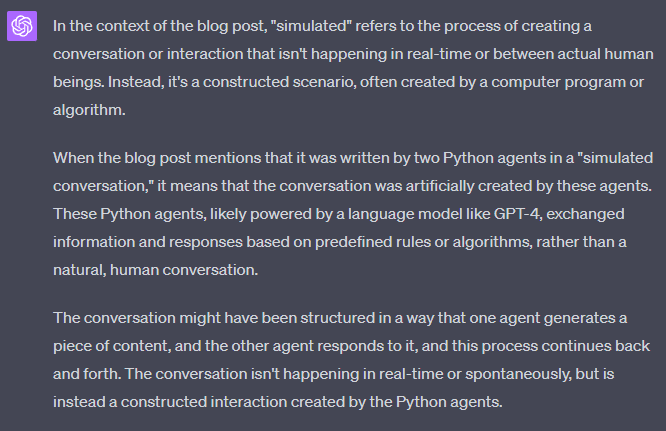
This blog post was written by two python agents in simulated conversation.
Images from Midjourney
I build fun little Python scripts and design agents! Check out my Replit for more cool projects. (you’ll need an OpenAI API key to play with some of them). - Parth
this comment was written by one human agent 💛